































Smart Ring vs Apple Watch Charging: Which One Misses Less Sleep Data?
If you want the shortest answer: a smart ring is structurally less likely to miss sleep data than an Apple Watch, mostly because of when it needs to charge and how it feels on the pillow. A modern smart ring typically runs several days on a charge and can be topped up during a shower or a morning coffee, which naturally leaves the whole night free for tracking. Apple Watch can absolutely record sleep, but its shorter battery life pushes many people into a nightly-or-nightly-ish charging habit that ends up eating part of the window you were trying to measure. Comfort matters just as much — a light ring is easier to forget about at 3 a.m. than a watch face pressed into your wrist. Whichever device you choose, the real fix is making the charging habit fit the sleep window, not the other way around.
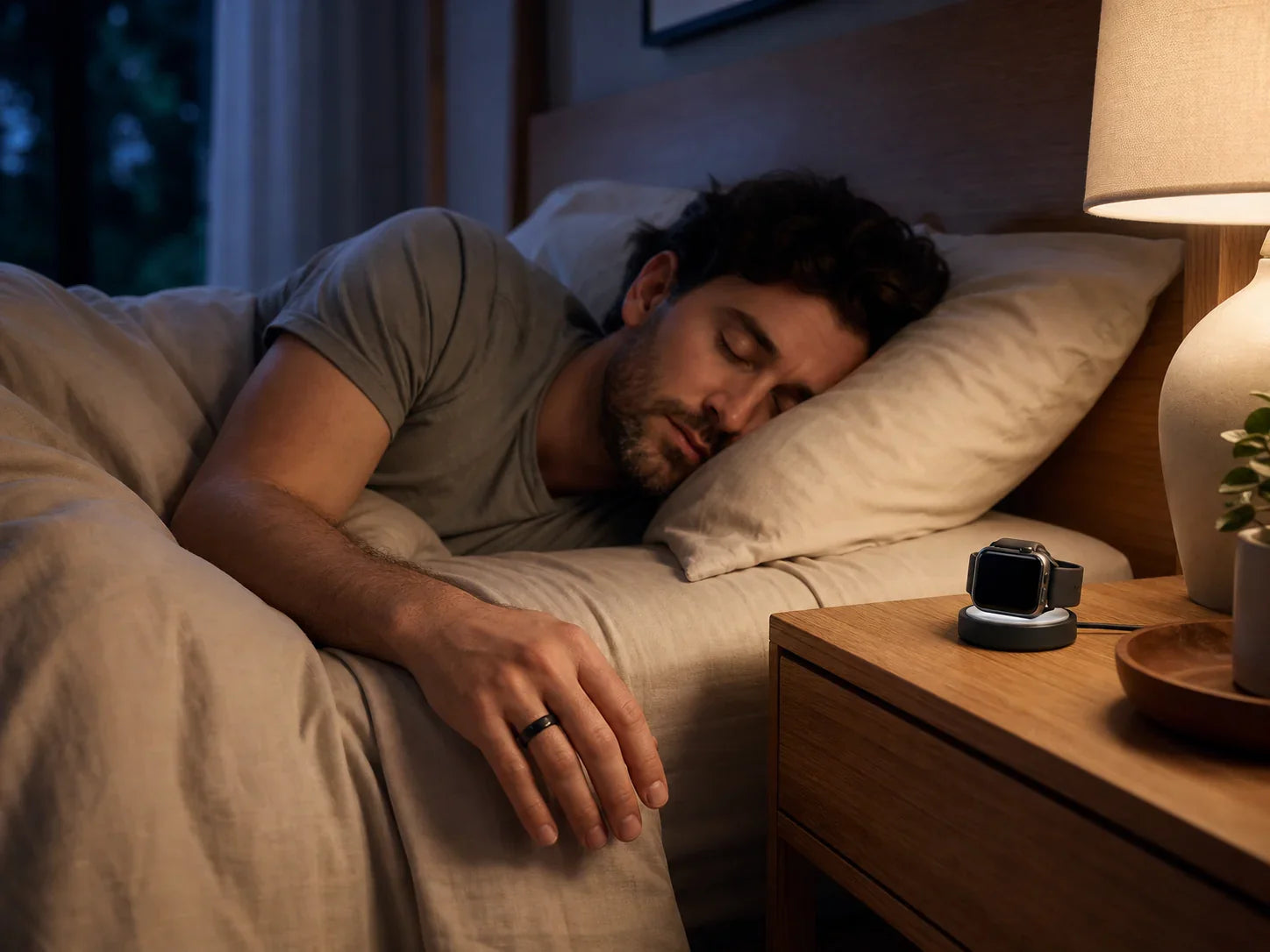
Why "missed sleep data" is really a charging-habit problem
Sleep-tracking gaps rarely come from a broken sensor. They come from the device being off the body, or off the body at the wrong hour. There are three usual causes: the wearable is on the charger when you fall asleep, it runs out of battery in the early morning, or you took it off in the middle of the night because it was uncomfortable. Each of these is a habit and hardware question, not a "which brand is more accurate" question.
That matters because it changes how you should compare a smart ring and an Apple Watch. Instead of arguing about signal quality, ask a simpler question: over a normal week, which device is more likely to actually be on your body from lights-out to alarm? That is the number that decides whether your sleep chart looks like a clean line or a fence with missing planks.
Battery life and the shape of a charging window
Battery life sets the shape of your charging window, and the charging window is what quietly decides whether sleep data survives the night.
Most modern smart rings — including JCVital's JCRing Med X3 and the lighter JCRing Air X6 — run several days on a single charge. That gives you a lot of freedom. You can plug the ring in during a shower, while you're making breakfast, or during a Zoom call, and still have full battery for the night. You do not need to think about it every day, and you rarely need to think about it before bed.
Apple Watch works differently. According to Apple's own guidance, Apple Watch supports sleep tracking, and Apple suggests topping up the battery before bed so it lasts the night, or charging in the morning when you wake up. The message is realistic and honest — Apple treats a short charge as part of the routine. In practice, though, this pushes users into a decision every single evening: charge now, charge at breakfast, or hope it lasts. That decision is where sleep data quietly disappears, especially on nights when you go to bed later than planned or forget the charger at the office.
The gap is not really "watch bad, ring good." It is that a multi-day battery gives you a wider, more forgiving window to top up outside of sleep, while a roughly one-day battery forces the window to sit close to bedtime.
Overnight wear comfort — the other half of the story
Even a perfectly charged wearable only tracks sleep if it stays on you all night. Comfort is what makes that happen without you thinking about it.
A smart ring is a small titanium or stainless-steel band that most people forget within a week of wearing it. There is nothing pressing into the top of your wrist, nothing digging in when you sleep on your side, no strap warming up under a duvet. For side sleepers especially, this is often the deciding factor. The ring stays on, so the sensor stays in contact, so the data keeps flowing.
An Apple Watch is a fantastic daytime device, but on the pillow it is a bigger object. Some people love the feel; others quietly slip it off at 2 a.m. and forget to put it back on. That silent removal — not sensor accuracy — is where most watch users lose part of the night on the chart.
Comfort is not just cosmetic. In smart-ring and smartwatch designs, PPG signals, skin-temperature trends, and movement all depend on stable contact with the skin, correct sizing, and consistent placement. A ring you never take off gives the algorithm a cleaner runway than a watch you sometimes remove.
How the data actually shows up
Sleep tracking on both devices generally covers time in bed, sleep stages, resting heart rate at night, and some form of overnight recovery signal. On the JCVital side, this shows up in the app as a nightly view plus longer-term trends for recovery and readiness — you can see the full picture on the sleep tracking page. On Apple Watch, similar information lives in the Health app, provided the watch was on your wrist for the relevant hours.
Here is the practical difference. If a ring skips a night, it is usually because you forgot to wear it or the battery finally ran out after a long trip. If a watch skips a night, it is often because part of the night was spent on the charger, or because it was taken off around bedtime and never went back on. The failure modes are different, and they hit different kinds of people. A frequent traveler with a chaotic schedule tends to lose more data on a watch. A side sleeper with sensitive skin tends to lose more data on a watch. A person who charges everything at their desk during the workday tends to do fine on either.
Which situations favor which device
There is no universal winner, but there are clear patterns.
A smart ring is the safer choice for pure sleep and recovery tracking if you want to charge on your own schedule, if you sleep on your side, if you share a bed and dislike a glowing screen at night, or if you already wear another watch during the day. A device like the JCRing Med X3 is designed around this exact use case, with a multi-day battery and a focus on sleep, recovery, and long-term trends. If you want something even lighter — for example, if you have slim fingers or prefer a lower-profile look — the JCRing Air X6 leans further into all-day comfort.
An Apple Watch is a stronger choice if you already rely on it for notifications, workouts, ECG, and Apple Health, and you are willing to build a firm charging habit — for example, charging every morning in the shower or every evening while you cook. If you can commit to that routine, sleep gaps mostly disappear. If you cannot, you will keep seeing partial nights.
For many households, the honest answer is not "one or the other" but "different tools for different jobs": a ring for the night and long-term trends, and whatever daytime watch you already like. JCVital's smart rings collection and smart bands collection are built around that idea — passive, low-friction wear for the parts of the day when a bright screen is not the point.
How to stop losing sleep data, whichever device you pick
You can eliminate almost all sleep-data gaps with three small habits.
First, pick a charging window that has nothing to do with sleep. Shower time, coffee time, or your commute all work. The point is to move charging out of the bedtime window entirely, so the device is always full when you lie down.
Second, size the wearable correctly. A ring that is slightly loose slides and loses contact; a ring that is slightly tight is uncomfortable and gets taken off. JCVital's size guide walks through this properly — fit is not a detail, it is the reason the sensor works.
Third, watch trends, not single nights. One missed night is normal life. A pattern of missing nights points to a habit problem: the device is on the charger too late, the strap is uncomfortable, or you are traveling without the charger. Both smart rings and Apple Watch reward the same behavior — consistent nightly wear — and both punish the same behavior, which is trying to squeeze the charge into the last hour before bed.
What this is not
None of this is a medical diagnosis. Consumer wearables — rings and watches alike — surface wellness trends and lifestyle signals. They are not substitutes for a sleep study, a doctor's assessment, or clinical monitoring for conditions like sleep apnea. If you have persistent daytime fatigue, loud snoring reported by a partner, or symptoms that concern you, talk to a healthcare professional. Use the ring or the watch to notice patterns and adjust habits, not to self-diagnose.
The short version
If your main goal is not losing sleep data to charging cycles or overnight discomfort, a smart ring has structural advantages: multi-day battery, easy off-peak charging, and a form factor most people forget they are wearing. Apple Watch can match it on data quality when the charging habit is disciplined, but the shorter battery leaves less margin for a messy week. Pick the device that fits the life you actually live, and build the charging habit around your day — not around your night. If you would like to dig deeper into what those nightly trends mean, JCVital's Health Insights blog is a good next stop.
FAQ
Does a smart ring really track sleep as well as an Apple Watch? For core sleep metrics — time in bed, sleep stages, resting heart rate, overnight movement — both devices give you a usable picture of wellness trends. The bigger driver of "accuracy" in daily life is consistent overnight wear, and smart rings tend to win on that because they are smaller and lighter.
How often does an Apple Watch need to be charged for sleep tracking? Apple's guidance is to top up before bed or when you wake up so the watch has enough battery for the sleep window. In practice, most users end up charging daily or close to it, and the trick is putting that charge outside of bedtime so it does not eat the night.
Can a smart ring last a full week on one charge? Modern smart rings, including the JCRing Med X3 and JCRing Air X6, are designed for multi-day use of up to about a week depending on model, features enabled, and usage. Real-world battery life will vary, but it is long enough that charging rarely collides with sleep.
Is it uncomfortable to sleep with an Apple Watch on? It depends on the person. Side sleepers, people with smaller wrists, and anyone sensitive to warmth under a duvet often find it uncomfortable. A ring is generally easier to forget about overnight.
Which one should I pick if I only care about sleep? If sleep and recovery are the whole point, a smart ring is the more forgiving choice — the battery, the form factor, and the low-friction charging window all line up with how nights actually work. If you also want notifications, workouts, and ECG on the same device, an Apple Watch with a firm charging habit is a reasonable pick.
Related JCVital guides
- JCRing smart ring collection
- Apple Watch vs JCRing sleep comfort
- Smart ring vs smartwatch for sleep tracking
- JCVital sleep and recovery articles
References
Apple — Charge your Apple Watch. https://support.apple.com/en-us/108936 Apple — Track your sleep with Apple Watch. https://support.apple.com/en-us/108906 Apple — Apple Watch battery. https://www.apple.com/batteries/maximizing-performance/ National Sleep Foundation — How Sleep Trackers Can Improve Your Health. https://www.thensf.org/how-sleep-trackers-can-improve-your-health/ American Academy of Sleep Medicine — Consumer sleep technology position. https://aasm.org/consumer-sleep-technology-should-not-replace-medical-evaluation/ Internal links to include Homepage — https://jcvital.com Smart rings collection — https://jcvital.com/collections/smart-rings Smart bands collection — https://jcvital.com/collections/smart-bands JCRing Med X3 product page — https://jcvital.com/products/jcring-med-x3 JCRing Air X6 product page — https://jcvital.com/products/jcring-air-x6 JCVital Pro V8 product page — https://jcvital.com/products/jcvital-v8-ecg-smart-band Sleep tracking feature page — https://jcvital.com/pages/sleep-tracking Stress & resilience feature page — https://jcvital.com/pages/stress-resilience Size guide — https://jcvital.com/pages/size-guide Health Insights blog — https://jcvital.com/pages/blog Image plan Cover image: a hand resting on a folded duvet at low bedside-lamp light, wearing a slim titanium smart ring, with a phone face-down beside it. Warm, quiet, no visible screen glare. Frames the article's core idea — a wearable that stays on through the night without demanding attention. Body image 1: side-by-side lifestyle shot of a smart ring on a nightstand next to a smartwatch on a charging puck. Suggests the charging-window contrast without any text overlays or brand competitor logos. Body image 2: close-up of a smart ring being slipped onto a finger in daylight (bathroom or kitchen counter, coffee cup nearby). Communicates the "charge during shower or coffee" habit visually. Body image 3 (optional): overhead shot of the JCVital app on a phone showing a clean weekly sleep trend line — highlights the "watch trends, not single nights" idea. No sensitive numeric overlays. Final self-check No body H1: yes No visible alt placeholders: yes Medical claims framed as wellness trends: yes Product facts treated conservatively: yes Direct GEO answer included early: yes